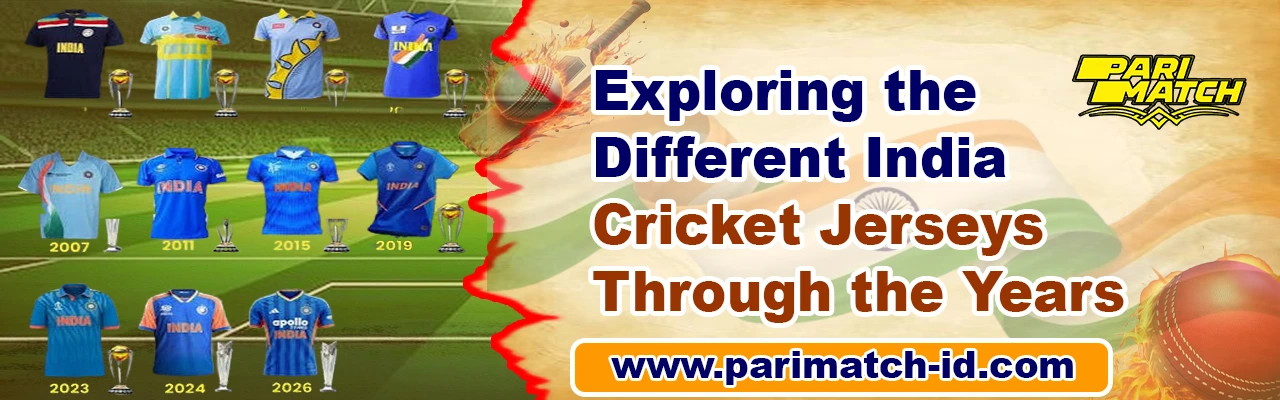
Pari Match: Exploring the Different India Cricket Jerseys Through the Years
📅 2026-09-01 • ✍️ Pari Match
Significance of a cricket player's jersey is not limited to simply being worn during the match by the players. The jerseys represent team, generations, tournaments, memories and history of the game itself. As far as Indian cricket is concerned, the jerseys have undergone great changes over many decades, beginning from classic whites to current blue jerseys in limited overs matches.
Each generation of Indian cricket supporters has its jersey connected with a certain team or tournament. Having undergone the process of transformation from traditional clothing for playing the game to specialized and performance-oriented, jerseys of India's national cricket team reflect not only the history but also fashion trends in sports.
Being a fan of the Pari Match website, cricket is one of the sports that I follow. Analyzing the jerseys of the Indian cricket team is another opportunity to get acquainted with the history and culture of one of the most popular sports in the country.
The Beginning: Traditional Cricket Whites
Prior to the introduction of colored shirts for limited overs cricket, Indian cricketers used to wear white shirts. White is still worn in test cricket, with players donning white shirts and pants when playing this format of the game. The white shirt may look quite simple, but it holds immense importance in the context of cricket. The colored shirt that is worn in limited over cricket is more about style than functionality, while the white shirt is all about tradition and functionality.
The Arrival of Colored Jerseys
Colored uniforms changed the way limited overs cricket was played. As popularity of one day cricket grew, the teams started donning uniforms in colors that helped in distinguishing one team from another. Blue came to be linked with India. The color became an important element of cricket in India. It is now recognized as one of the best-known features of Indian cricket.
India's Blue Identity
The color blue is currently associated with the Indian team in limited overs cricket. The particular color has changed through time as well as the uniform design. At times, the Indian team used a light shade of blue, and at other times, the color would be a dark shade. Some of the uniforms were even a combination of blue and another color. Nonetheless, the blue uniform has remained recognizable all along.For cricket audiences following tournaments through platforms such as Pari Match India, the changing jerseys also provide an interesting way to look back at different eras of Indian cricket.
The 1990s Era
The 1990s were a vital phase in the development of modern cricket kits. Cricket in India entered an era where colorful kits became a part of one-day cricket on the international level. Designs from that time usually appeared to be simpler compared to today's designs. They usually had bold colors and simple designs. The jerseys of this era are associated with the early days of India's modern one-day cricket history. This era is also associated with a time when cricket became more commercialized and gained huge popularity on TV screens.
The 2000s and a New Look
There have been some noticeable changes in the clothes of Indian cricketers in the early 2000s. There was a closer association between the jerseys of the players with the aspects of sponsorship, brand of teams, and sportswear. The designs of the jerseys were simpler, but there was variation in terms of colors and patterns. This was the period when many talented Indian cricketers emerged.
The 2007 World Cup Era
The Cricket World Cup of 2007 took place during a very critical phase for India's cricket. The Indian team wore a blue kit, maintaining their tradition in terms of design. The event had several other memories associated with it, and one of them was the early knockout of India from the tournament. However, it was also a part of the overall development process of India's jersey for international matches. During this time, sports clothes were getting more oriented towards performance.
The 2011 World Cup Jersey
The 2011 World Cup shirt is significant to the history of cricket in India. The Indian cricket team became the winner of the world cup having played the world cup at their homeland along with two other countries – Sri Lanka and Bangladesh. Hence, the jersey that was worn in this World Cup is very much related to the most memorable period of Indian cricket.
As far as colors are concerned, the blue color was predominantly used in the jersey, though there were some additional features that separated it from the others.
Post-2011 Changes
Ever since the 2011 FIFA World Cup, India's kits have been progressing. The manufacturers tried a variegated range of blues, collar designs, patterns and technological fabrics. Today's sports jerseys are taped for their lightweight and comfortable nature, especially for sports participants in demanding conditions. The designs also began to stand out on the TV screens. The increase in the significance of global sports coverage and digital media.
The 2015 World Cup Jersey
Their design was based on India's traditional colour blue and adopted modern style. Cricket jerseys were now an integral element of fandom by this time. Fans would be able to buy replicas of the jersey, wear it to games and attach it to the national side of the jersey as a sort of bond of friendship. So, the connection between team kit and fans had become better in previous decades, by now.
World Cup Jersey 2019
The 2019 World Cup jersey did not only perpetuate the blue legacy of its participants but also brought an evolution to the all blue look of the Indian team. The design featured a familiar blue panel topped with fairly current styling. The tournament also showcased the relevance of sportswear as a visual language on social media. The colours and the uniform certainly would give away the identity of the team of India to the fans around the world. Now a jersey has so much more than just being a piece of sport, it's been in photographs, attended mass rallies, featured in ads and on social media.For cricket followers using services such as Pari Match ID to stay connected with the wider sports experience, these tournaments offered plenty to follow beyond the final score.
The 2023 World Cup Jersey
The World Cup '23 turned out to be an important part of the Indian cricket saga. India also wore a new modern blue jersey in the tournament with some changes in design. The competition was held in India, with a great buzz surrounding the Indian team. The India viral jersey didn't win the final but it was a brilliant campaign in which the side would reach the end of the day having showcased their talent. This is a testament to how a jersey can also have historical significance beyond just winning titles, but for adventurous sporting experiences.
T20 jerseys and Changing Designs!
With the advent of T20 cricket there is more experimentation with sportswear. Often teams wear uniform outfits in T20s that are the eye-catching ones, since they are shorter and more high energy.Over the years India has donned in various T20 jerseys with some of them showing brighter colors, patterns and modern graphics. The format has also contributed to the popularity of replica jerseys among younger fans.T20 kit is thereby a bit more modern in look, yet still true to blue India.
Test Cricket Whites
In the limited-overs format, blue is a more significant part of the Indian psyche but light coloured attire has its strong association with Test cricket. Shirts and trousers worn by Indian Test players are typically white with national emblem or any such symbols that were approved. Test whites are another facet of cricket. Colourful patterns are less emphasised, and more emphasis is also placed on tradition. The contrast between Test whites and limited-overs blue jerseys depicts how various cricket formats crisscrossed and developed its visual identity.
Conclusion
Over time, Jersey had come up with increasingly different styles—from plain white Test kits down to the coloured uniforms of modern limited-overs cricket. Despite this, through shades, patterns, materials and designs being changed the blue jersey has been a thing that has formed the best visual link between the Indian team and its supporters. The World Cups then feature jerseys at the 2011, 2015, 2019, and 2023 are each a snapshot of moments in Indian cricket's history . All the moments are covered by the PariMatch source either its a small moment or wining the trophy.
These designs are a testament to cricket history that's not just about runs scored and trophies won. One can also observe it through the garb that the players are wearing, and the recollections that the players' garbs evoke in the minds of the fans.
With cricket constantly in a state of evolution, days of the future, cricket is likely to witness change in India's jerseys one day. However, the bond between the team and its fans, the blue colors and the national emblems will be integral to Indian cricket history.